- Monday - Saturday 08:00-18:00
- +91 97004 28610
- +91 8143621111

Industrial Infrastructure Development, Factory Construction and Facility Engineering Solutions
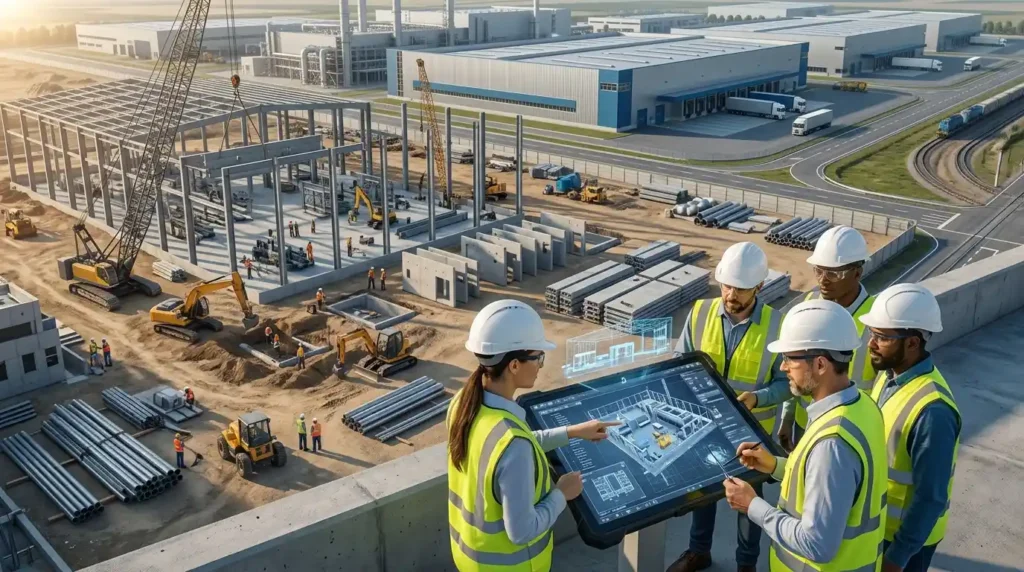
Introduction to Industrial Infrastructure Development Systems
Modern industrial growth depends heavily on structured industrial infrastructure development that supports large-scale production, logistics, and operational efficiency. Every factory, warehouse, and manufacturing unit requires carefully planned engineering systems to ensure smooth functionality and long-term performance.
In today’s competitive environment, factory construction and industrial facility planning are not just about building structures but about designing complete ecosystems that support machinery flow, workforce movement, and utility integration. Without proper industrial infrastructure planning, businesses face inefficiency, downtime, and operational losses.
Engineering teams focus on creating scalable systems that can support future expansion while maintaining current performance stability. This makes industrial infrastructure one of the most critical parts of modern economic development.
Industrial Site Planning and Facility Layout Engineering
The success of any industrial project begins with strategic site planning. Engineers analyze land availability, transportation access, raw material flow, and production requirements before finalizing layouts.
In industrial infrastructure development, layout design ensures that every section of the facility operates efficiently without workflow congestion. Factory zones are divided based on production stages, storage needs, and logistics movement. Proper planning in factory construction reduces material handling time and improves productivity by optimizing internal movement paths and operational sequences.
Heavy Duty Structural Engineering for Industrial Facilities
Industrial buildings require stronger structural systems compared to residential or commercial buildings. They must support heavy machinery, continuous operations, and vibration loads.
In industrial infrastructure, structural frameworks are designed using reinforced concrete and high-strength steel to ensure durability under extreme operational conditions. Engineers carefully design load-bearing columns, flooring systems, and roofing structures to handle industrial stress levels without deformation or failure.
Strong factory construction methods ensure long-term operational safety and reduce maintenance costs significantly.
Warehouse Design and Storage Optimization Systems
Warehouses play a critical role in supply chain and logistics management. Proper design ensures smooth storage, retrieval, and transportation of goods.
In industrial infrastructure development, warehouse planning focuses on maximizing storage capacity while maintaining easy accessibility. Efficient design reduces loading and unloading time, improving overall productivity.
Modern warehouse construction includes optimized shelving systems, wide movement lanes, and automated handling compatibility to support large-scale operations.
Utility Integration and Industrial Support Systems
Industrial facilities depend on continuous utility supply systems such as electricity, water, ventilation, and waste management. Without these systems, operations cannot function smoothly.
In industrial infrastructure development, engineers design integrated utility networks that support uninterrupted production cycles. These systems are carefully aligned with facility layouts to avoid disruptions. Proper factory construction ensures that utility lines are safely embedded within the infrastructure without interfering with production workflows.
Material Selection and Industrial Durability Standards
Material quality plays a major role in industrial infrastructure performance. Since factories operate under heavy loads and continuous usage, materials must be highly durable and resistant to wear.
In industrial infrastructure, steel, concrete, and industrial-grade flooring materials are selected based on load requirements and environmental conditions. Strict quality standards ensure that factory construction projects maintain long-term strength, reducing repair and replacement costs over time.
Safety Engineering in Industrial Construction Systems
Safety is a critical component of every industrial project. Factories and warehouses must follow strict safety guidelines to protect workers and machinery.
In industrial infrastructure development, safety systems include fire protection, emergency exits, structural stability checks, and hazard prevention designs.
Proper factory construction integrates safety features directly into the design phase rather than adding them later, ensuring full compliance with industrial regulations.
Expansion Planning and Future-Ready Industrial Design
One of the most important aspects of industrial engineering is scalability. Facilities must be designed in a way that allows future expansion without major reconstruction.
In industrial infrastructure development, engineers design modular systems that can be expanded as production demands increase. Future-ready warehouse construction and factory layouts ensure that businesses can grow without operational disruption or structural redesign.
Conclusion
Industrial development is a foundation for economic growth and production efficiency. Proper industrial infrastructure development ensures that factories, warehouses, and production units operate smoothly and efficiently.
From planning to execution, every stage of factory construction requires precision, engineering knowledge, and long-term vision. Without structured systems, industrial operations face inefficiency and increased operational costs.
Modern industrial infrastructure focuses on scalability, durability, and integrated system design. When engineering, planning, and execution align properly, industrial facilities become highly efficient, safe, and future-ready.
FAQs
It is the planning and construction of factories, warehouses, and industrial facilities.
It ensures efficient production flow and long-term operational stability.
It is the structured planning of storage systems for efficient logistics management.
It ensures continuous supply of electricity, water, and ventilation systems.
Through structural design, fire systems, and engineering compliance standards.